Is CRNA School Actually Worth It: The Brutally Honest ROI Analysis
Everyone in the ICU has a CRNA they look up to.
You know the one. They walk in calmly, take control of a room, make decisions that matter, and walk out at a reasonable hour. They show up during the most exciting times in the ICU and nothing flusters these people.
They’re not getting crushed by a 1:2 ratio at 0400. They’re not fielding call lights. They built a career that works for them both clinically and financially.
So you start doing the math. Or you think you’re doing the math.
“CRNAs make $200K. I make $95K. That’s a no-brainer.”
Except that’s not the math. That’s one number on one side of the ledger. The real calculation is messier, more expensive, and more nuanced than any forum post or recruiter pitch will tell you. And depending on your specific situation, your age, your program cost, your market, your debt tolerance, CRNA school is either one of the best financial decisions available in healthcare, or a move that puts you behind for a decade before you catch up.
This post runs the real numbers. All of them.
First, Let’s Talk About What CRNA School Actually Costs
Most people fixate on tuition. That’s the wrong number to anchor on.
Yes, tuition matters. CRNA programs range from roughly $60,000 at affordable public institutions to well over $185,000 at private programs. One even costs $300,000. That’s a real spread. Program selection alone can mean a $125,000+ difference in your starting debt load. We’ll come back to that.
But tuition is only one layer of the true cost stack. Here’s what you’re actually spending:
Tuition and fees: $60,000–$185,000+
Living expenses during school: CRNA programs are full-time doctoral programs. You are not working. If you are, it’s a few shifts per month for the first year.
The costs for 3 years of rent, food, transportation, insurance, and whatever your life looks like adds up fast. Model this conservatively at $2,500–$4,500 per month depending on your market and family situation. That’s $90,000–$162,000 over three years. And that’s before you have kids, a mortgage, or a spouse who took a step back in their career to support yours.
Loan interest: Federal graduate unsubsidized loans are currently sitting above 8%. On a $150,000 principal balance, you’re watching $12,000+ per year accrue in interest before you write your first post-graduation paycheck. That compounds. It matters.
Lost income is a number almost nobody counts: This is the one that changes the entire analysis, and it’s the one that gets quietly omitted from every “is CRNA school worth it” article written by someone trying to sell you on a prep course.
If you’re making $80,000–$130,000 as a seasoned ICU nurse, and you stop working for three years, that’s $240,000-$390,000 in income you didn’t earn. It didn’t go into your retirement accounts. It didn’t compound. It didn’t pay down your mortgage. It simply didn’t happen.
Stack it all together and here’s what you’re actually looking at:
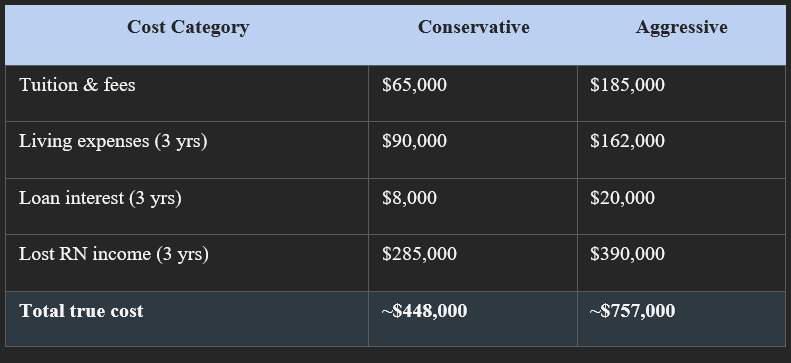
That’s the real number you’re weighing against the income upside. Not the tuition brochure. The full stack.
Why CRNA School is Still Compelling…
Here’s where the story gets genuinely good, if you do the work to understand it correctly.
The Bureau of Labor Statistics puts average CRNA compensation at $231,700 per year. The AANA compensation survey has CRNA W-2 wages at $250,000 per year. The average RN pulls $98,430. That’s an annual gap of roughly $133,000 in favor of the CRNA every single year, for as long as you work.
Run that delta over a career and the numbers are hard to argue with.
• Over 20 years: $2.66 million in additional income
• Over 30 years: $3.99 million in additional income
This is a linear, back-of-the-napkin calculation. Even after you subtract taxes, loan payments, and the lost-income years of school, a 30-year CRNA career generates somewhere between $2 million and $4 million more in lifetime earnings than staying an RN.
That is a legitimate, meaningful return on a professional credential. The spread increases when accounting for annual wage growth and compounding investment returns. Regardless, the difference is meaningful.
But…and this is the part that matters…that lifetime surplus only materializes if you actually work the full career runway. Which brings us to the variables that determine whether this math works for you specifically.
The Four Variables That Change Everything
The difference between “CRNA school was the best financial decision I ever made” and “I’m still grinding down this debt at 52” almost always traces back to one of these four inputs.
1. Age at entry
A 28-year-old entering CRNA school and a 44-year-old entering CRNA school are not making the same investment, even if they attend the same program and graduate with identical debt.
The 28-year-old has 35+ years to compound the income advantage. The break-even point is a speed bump. The 44-year-old has a shorter runway, higher opportunity cost on the lost income years, and potentially less time to aggressively pay down debt before retirement becomes a real conversation.
This is not a reason not to go at 44. Plenty of CRNAs enter later and build excellent careers and strong financial positions. But the math is different, and it deserves honest eyes.
2. Program cost
A $65,000 public program and a $185,000 private program are not interchangeable choices. Both produce a DNP. Both produce a CRNA eligible to sit for the NCE. But one of them starts you $120,000 deeper in debt.
At an 8% interest rate on a 10-year repayment plan, that $120,000 difference costs you roughly $1,460 more per month in loan payments for a decade. That’s real money — it’s a car payment, a vacation, or the difference between maxing your Solo401(k) and not.
If two programs are both accredited, have strong board pass rates, and place graduates in competitive markets, the cheaper one is usually the right answer. Prestige in CRNA education does not work the same way it does in law or business school.
3. Geography and market
CRNA salaries are not uniform. A CRNA in Illinois averages over $280,000 per year. A CRNA in Florida earns 30% less. That’s a $100,000 annual difference for the same credential, same hours, same skill set.
Rural shortage areas and states with full practice authority, where CRNAs can practice completely independently, consistently pay at the top of the range. Heavily saturated urban markets with large academic medical centers employing staff CRNAs on flat salaries sit at the other end.
Geography is not a detail. For a CRNA, it can be the single largest lever on lifetime earnings, bigger than program choice, bigger than negotiating a raise, bigger than most financial decisions you’ll make. Know your target market before you commit to a program.
4. Debt management post-graduation
How you handle $150,000–$300,000 in student debt in the first five years after graduation determines whether CRNA school was a great investment or a long, expensive drag.
The aggressive payoff strategy works well. Embrace the Moneymoon and throw 30%+ of your gross income toward loans and retirement for 3–5 years before optimizing everything else. Remove the consumer debt in your life and optimize tax-advantage accounts.
The passive income-driven repayment strategy can feel comfortable monthly but often costs more in total interest and delays real wealth building by years. Just pay off your loans.
And if you’re planning on Public Service Loan Forgiveness as a hospital-employed CRNA, understand the current landscape before you count on it. The rules have changed, but remain unforgiving. The tax treatment of forgiven balances has changed. Build your strategy on the current law, not the version you read about in 2022.
The Break-Even Model: Real Numbers, Real Person
Here’s a concrete example worth walking through.
Profile: Jamie, 30-year-old CVICU RN, currently earning $100,000/year, accepted to a public CRNA program. Total debt at graduation: $200,000. Starts working at 33, first-year CRNA salary: $230,000, in a mid-cost market.
Scenario A: Jamie stays an RN
• Earns $100,000 with a 3% adjustment for the next 30 years.
• No school debt
• Saves 20% for retirement
• Total lifetime earnings (30 years, modest growth): ~$5 million gross
Scenario B: Jamie becomes a CRNA
• Three years of zero income + $200,000 in debt
• Aggressive payoff: debt cleared by age 38
• Earns $230,000 with a 3% adjustment for 27 years
• Total lifetime earnings (27 years, modest growth): ~$9.9 million gross
Income advantage of the CRNA path: $5,000,000 over the career.
The crossover point in this model where net worth of the CRNA is greater than the RN is age 48. Sounds like a long time right. Hold on a minute…
There are a few major factors overlooked in this simplified example. ONE, the max earning potential for a CRNA is WAYYY higher. Travel nurses may earn $200,000+. Locum CRNAs with similar hours are high six-figures. One or two years as a locum negates this entire example.
TWO, both the RN and CRNA were investing 20% of their gross income. Although the CRNA will have a higher effective tax rate, they are taking home more money. The CRNA is living in a bigger house, driving nicer vehicles, and taking more expensive vacations.
THREE, the simulation stops at age 60. If we stretch this out, the CRNA’s portfolio with continue to compound at a higher rate than the RN’s portfolio.
FOUR, current CRNA positions are commonly offering healthy sign-on bonuses. It’s not uncommon to see $50,000 to $150,000 paid up front for a 5-year commitment.
The scenario gives every advantage to the RN.
For Jamie at 30, that’s highly worth it.
The Non-Financial Side
Real, But Know Which Column It Goes In
There’s a reason financially sharp people still choose CRNA school even in the tighter scenarios. Not everything belongs in the spreadsheet.
Clinical autonomy is real. In most states, CRNAs practice independently. You’re the provider. You’re making the calls. For people who spent years in the ICU being good at medicine while technically being a nurse, that matters.
Physical sustainability matters. Thirty years of bedside nursing extracts a real toll on the lower back. CRNA work is demanding but differently demanding — cognitively intensive, not physically grinding. The career longevity argument is legitimate.
The stereotype about anesthesia and comfortable chairs is real.
Credential portability is underrated. A CRNA license is one of the most flexible credentials in healthcare. Locum work, rural placements, travel contracts, independent practice. You can shape your schedule in ways that staff RNs simply cannot.
These are real factors. But they don’t pay your loans. Keep them in a separate column from the financial calculation, weigh them seriously, and let them inform the decision. Just don’t let them substitute for the math.
Who the Math Works For
This is not a post that ends with “CRNA school is worth it for everyone who wants it badly enough.” That’s not honest and it’s not useful.
The math works well if:
• You’re under 38 at entry
• You’re targeting a lower-cost program (under $100K tuition)
• You’re willing to be geographically flexible toward high-demand markets
• You have a household income during school (working spouse/partner)
• You commit to aggressive debt payoff in the first 1-5 years post-graduation
The math works, but requires discipline, if:
• You’re 38–44 at entry
• Mid-cost program, average market
• Dual income household
• Manageable living expenses
• Realistic about debt strategies
The math gets hard if:
• You’re over 44 with limited career runway
• Expensive private program with no geographic flexibility
• Single income,
• High cost-of-living area
• Passive repayment plan on $250K+ in debt
None of this is disqualifying. But if you’re in the third column and going in without a clear financial plan, you are betting on income alone bailing you out. Sometimes it does. Sometimes it doesn’t.
The Bottom Line
CRNA school is one of the highest-return professional investments available in American healthcare. The income ceiling, the autonomy, the credential flexibility, the career longevity — the full package is genuinely compelling.
But the people who come out ahead financially aren’t the ones who were most inspired on their application. They’re the ones who ran the real numbers before they committed. Who knew their total cost stack, their target market, their break-even timeline, and their debt payoff plan…and then executed.
The people who struggle aren’t bad at anesthesia. They’re people who anchored on the headline salary, picked an expensive program without thinking hard about it, graduated into a saturated market, and defaulted to the path of least resistance on their loans.
You are reading a personal finance site for CRNAs. You are not that person.
Do the math. Know your numbers. Then go become a CRNA with your eyes open. I have dozens of blog entries walking you through just how lucrative the profession can be. There aren’t many advertising financial independence in 5-10 years. It’s all about what you want out of life.
Thanks for reading.